Workflow for User Research to Boost SaaS Product Adoption

Finding true product-market fit is a moving target for growth-focused SaaS teams, yet research often gets derailed by unclear goals or mismatched stakeholder expectations. Product managers know that strong user research is the backbone of smart adoption strategies, but aligning diverse priorities within your organization can feel overwhelming. By focusing on comprehensive stakeholder engagement and tailoring every step—from defining research goals to sharing results—you set a foundation for discoveries that spark real business impact.
Table of Contents
- Step 1: Define Research Goals And Stakeholder Needs
- Step 2: Plan User Recruitment And Select Methods
- Step 3: Conduct User Sessions And Capture Insights
- Step 4: Analyze Data And Extract Actionable Findings
- Step 5: Validate Results And Share Recommendations
Quick Summary
| Key Insight | Explanation |
|---|---|
| 1. Define Clear Research Goals | Establish specific, measurable goals based on diverse stakeholder needs to guide your user research effectively. |
| 2. Tailor Participant Recruitment | Create a clear profile for participants, focusing on those who match your current research needs to ensure relevant insights. |
| 3. Synthesize Qualitative Data | Analyze user interview notes to identify common themes and actionable findings, separating meaningful patterns from noise. |
| 4. Validate Your Findings | Cross-reference research insights with multiple data sources to confirm they reflect broader user experiences before presenting. |
| 5. Share Actionable Recommendations | Present findings clearly, highlighting key issues and proposed solutions tailored to different stakeholder interests for efficient decision-making. |
Step 1: Define research goals and stakeholder needs
Before you launch into any user research initiative, you need absolute clarity on what you’re actually trying to learn and who cares about the answers. This step sets the foundation for everything that follows. Without clear research goals, you’ll end up collecting data that doesn’t move the needle on adoption, wasting time and resources on insights that don’t translate into product decisions.
Start by identifying all the players who have a stake in your product’s adoption. This goes beyond just the end users. You’re looking at product managers, engineers, customer success teams, sales leaders, and executives who need different information to do their jobs well. Each stakeholder group has distinct priorities and constraints. A sales leader wants to understand why prospects abandon trials, while your customer success team needs to know which features confuse new users during onboarding. These aren’t the same research questions, even though they’re investigating the same product.
Run a structured stakeholder mapping session with key people across your organization. Ask them directly: What adoption challenges keep you up at night? What would change your roadmap decisions? What metrics matter most to your team? You’ll likely discover that stakeholders have competing priorities or different assumptions about why users aren’t adopting your product. Document these differences explicitly. Understanding how diverse stakeholder perspectives shape innovation priorities helps you create research goals that actually address the real blockers rather than surface-level questions.
Once you’ve heard from stakeholders, synthesize their input into 3-5 clear, measurable research goals. Instead of “Understand user onboarding,” aim for something specific like “Identify the top three reasons new users fail to complete their first workflow in the first week.” Frame goals around adoption outcomes, not just user behavior. What adoption milestone matters most right now? Is it activation after signup? Feature discovery within the first month? Long-term retention? Anchor your research goals to the adoption stage your business needs to improve.
Here’s a summary of common stakeholder groups and their primary adoption research interests:
| Stakeholder Group | Main Adoption Concern | Typical Insights Sought |
|---|---|---|
| Product Manager | Product features adoption | Key blockers and user needs |
| Sales Leader | Conversion and trial abandonment | Reasons prospects disengage |
| Customer Success | Onboarding and user confusion | Feature misunderstandings |
| Engineering | Technical usability barriers | Issues causing user drop-offs |
| Executives | Impact on business metrics | Adoption stage affecting growth |
Remember that research goals should change as your product and market evolve. The goals that mattered when you had 500 customers look different when you hit 5,000. Schedule a stakeholder alignment session every quarter to revisit whether your research priorities still track with business reality. This keeps your research workflow responsive rather than locked into outdated questions.
Pro tip: Write your research goals and stakeholder needs as shareable one-pagers and circulate them before starting fieldwork. This forces clarity, prevents scope creep, and ensures everyone’s pulling in the same direction when you present findings.
Step 2: Plan user recruitment and select methods
With your research goals locked in, you need to figure out who you’re talking to and how you’ll find them. This step determines whether your research findings actually represent your users or just a convenient subset of people willing to chat with you. Bad recruitment means bad data, no matter how well you execute the interviews.

Start by defining your ideal participant profile based on the adoption challenges you identified in the previous step. If you’re researching why new users abandon onboarding, you need people who recently went through that experience, not power users who’ve been with you for years. Get specific about who matters. Are you looking for users in a particular industry? Company size? Experience level? Geographic location? Create a recruitment screener that filters for these attributes before you invest time with anyone. The more precise your participant criteria, the more your findings will actually apply to your product decisions.
Next, decide on your recruitment channels. You can recruit from your existing user base through in-app prompts, email campaigns, or your customer success team’s relationships. You can work with research platforms like Respondent or UserTesting. You can post on community forums, LinkedIn, or Slack communities where your target users hang out. Each method has tradeoffs. Your existing users know your product but might sugar-coat feedback. External platforms give you fresh perspectives but cost more and take longer. The best approach usually combines multiple channels. Internal recruitment reaches people who understand your product context, while external recruitment ensures you’re not stuck in an echo chamber. Addressing participant recruitment challenges like diversity and bias strengthens your research validity and helps you build a representative sample that actually reflects your user base.
Determine how many people you need to talk to. For adoption research, 8 to 12 qualitative interviews usually surface the major patterns and blockers. You don’t need hundreds of people to find the common reasons users struggle. Once you start hearing the same feedback repeatedly, you’ve hit diminishing returns. If you’re doing quantitative validation later, you’ll need larger numbers, but during exploratory research, depth beats volume.
Plan your recruitment timeline aggressively. Good participants don’t materialize overnight. Factor in time for outreach, screening, confirmation, and no-shows. Aim to have your first interviews scheduled at least two weeks out. Build in buffer time because recruitment always takes longer than you expect.
Pro tip: Offer a small incentive to participants even if they’re existing customers. Twenty-five dollars or a three-month subscription extension signals respect for their time and dramatically increases show-up rates, which saves you from wasting research budget on empty calendar slots.
Step 3: Conduct user sessions and capture insights
Now comes the work that actually moves the needle. You’re sitting down with real users to understand why they struggle with your product and what would make adoption smoother. This is where raw feedback transforms into actionable product decisions. The quality of your sessions directly determines whether your research becomes a roadmap priority or gathers dust in a shared folder.
Start each session by building trust and framing the conversation. Tell participants you’re not testing them or the product, you’re testing your own assumptions about how people use what you built. This removes the pressure they feel to be “good test subjects” and opens them up to honest feedback. Begin with warm-up questions that get them talking about their work, their challenges, their typical day. These aren’t data collection questions, they’re conversation starters that help people relax. Then move into your core research questions, but stay flexible. If a participant mentions something unexpected that relates to adoption, follow that thread. Your interview guide should be a compass, not a prison.
During the session, practice active listening instead of interrogation. Ask follow-up questions like “Why did that frustrate you?” or “What were you trying to accomplish there?” These open-ended prompts reveal the motivations behind behaviors. When users say something vague, dig deeper. If someone says “the interface is confusing,” that’s not useful feedback. But if you ask what specifically confused them and what they expected instead, you get information that changes how you design. Record the session if participants consent. Video is gold because you capture tone, hesitation, and emotion that transcribe poorly. Take notes during the session, but don’t transcribe every word. Focus on capturing direct quotes from participants about adoption obstacles, aha moments, and points where they got stuck.
Combining direct user conversations with product usage data gives you a complete picture of adoption patterns. You’ll see what users say they do versus what your analytics show they actually do, and those gaps reveal massive learning opportunities. After each session, spend 15 minutes writing a summary while the conversation is fresh. Capture the key finding about adoption, one illuminating quote, and any design questions the session raised. This lightweight approach keeps insights actionable instead of buried in hours of video.
As you move through multiple sessions, you’ll start noticing patterns. That’s when you know you’ve hit research saturation. Document these patterns explicitly. If six out of eight users abandoned onboarding at the same step, that’s a finding worth pursuing. If three users had completely different reasons for struggling, those are edge cases worth understanding but probably not your highest priority.
Pro tip: Have someone else take notes during interviews so you can focus entirely on the participant and listen for what’s not being said. The person taking notes should also flag follow-up questions in real-time so you don’t lose momentum chasing a thought.
Step 4: Analyze data and extract actionable findings
You’ve conducted sessions, recorded feedback, and filled pages with notes. Now you need to transform that raw material into findings that actually influence your product roadmap. This step separates research that matters from research that becomes background noise. Without rigorous analysis, you end up chasing the loudest voice instead of the most important pattern.
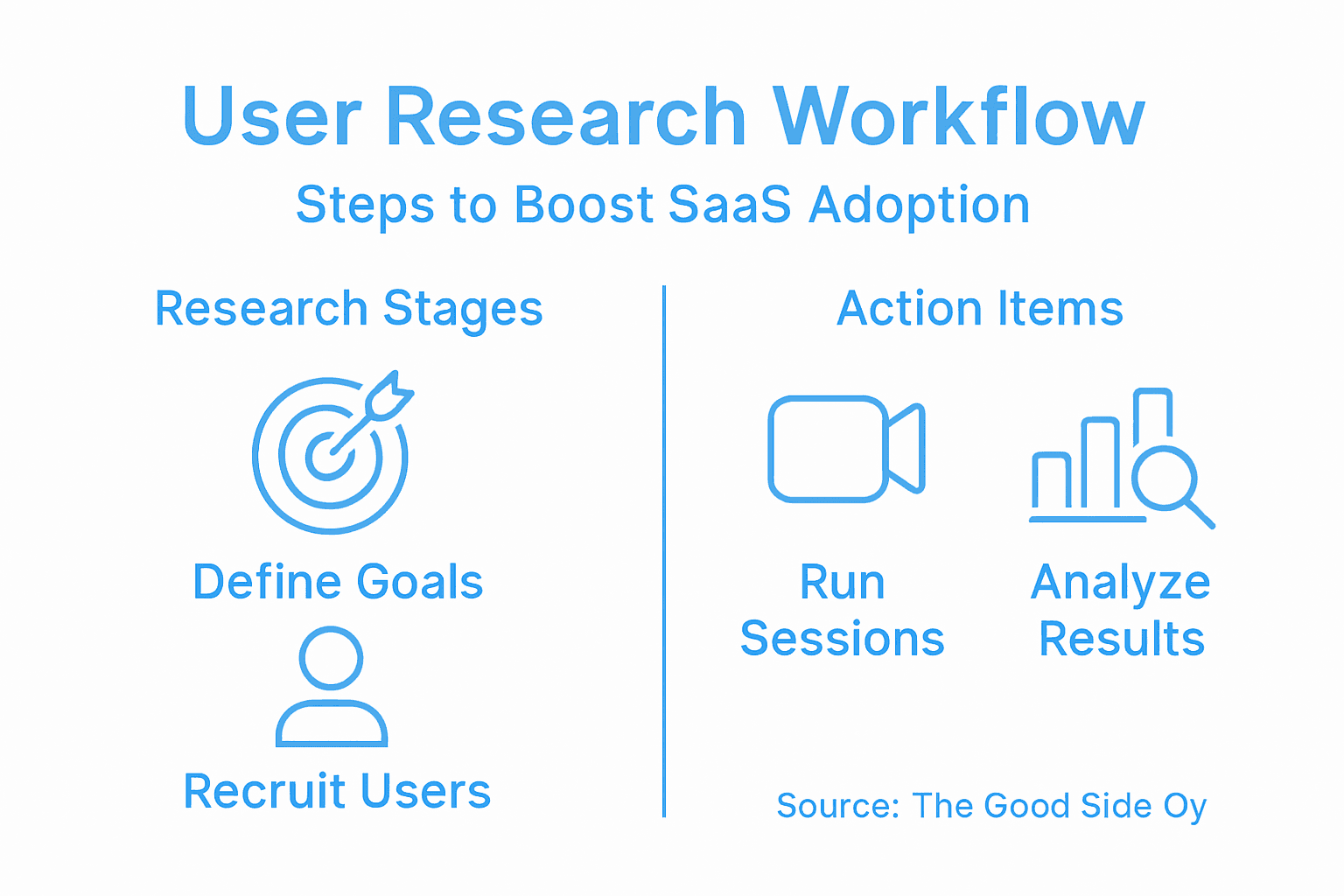
Start by organizing your qualitative data. Compile all your session notes, quotes, and observations in one place. Read through everything at least once to get familiar with the complete picture. Then go through again and identify recurring themes. Look for moments where users got stuck, expressed frustration, or surprised you with unexpected workarounds. If three or more participants mentioned the same adoption blocker, flag it. If only one person struggled with something, note it but recognize it as an edge case. The goal is to separate signal from noise. Create a simple tracking sheet with each major theme, how many users experienced it, and representative quotes that illustrate why it matters. This transparency helps your team understand that findings are grounded in actual user behavior, not just your hypothesis.
Now layer in your quantitative data. If your analytics show that 40 percent of users leave after day three, correlate that timing with what your interviews revealed about that stage of onboarding. Did users get stuck on a specific feature? Did the value proposition become unclear? Merging quantitative metrics with qualitative user feedback reveals the complete story. Users might say they abandoned because a feature was confusing, and your analytics confirm they clicked around the same area repeatedly before leaving. That convergence proves the adoption problem and points directly to the solution. Conversely, if your analytics show high feature usage but interviews reveal frustration, you’ve found a usability problem that impacts satisfaction even if adoption metrics look okay.
This table compares qualitative and quantitative research methods in adoption studies:
| Aspect | Qualitative Methods | Quantitative Methods |
|---|---|---|
| Data Collected | User interviews, direct feedback | Analytics, usage statistics |
| Sample Size | 8-15 typical | 100+ preferred |
| Insights Provided | Deep user motivation and pain | Adoption trends, behavior |
| Main Limitation | Hard to generalize findings | Lacks detailed context |
Prioritize findings by impact and reach. A blocker that affects 80 percent of new users and prevents activation deserves immediate attention. A workflow confusion that affects 20 percent of power users after three months is lower priority. Be honest about which findings align with your business goals versus which are interesting but tangential. Your research goals from step one should guide this prioritization. If you set out to understand why onboarding abandonment happens, findings about feature requests are interesting context but not your primary deliverable.
Finally, translate findings into actionable recommendations. Instead of “users find the interface confusing,” articulate the specific problem and suggest a direction forward. Maybe it’s “Users don’t understand that the left panel contains their project settings because the label says ‘Workspace’ and they expected ‘My Project.’ Consider renaming or adding an icon to clarify function.” Specificity makes the difference between a finding your team acts on and one they debate endlessly.
Pro tip: Create a findings matrix that maps each adoption blocker to which stakeholder cares about it most. This helps you tailor your presentation when you share results, emphasizing the insights that will resonate with product leadership, customer success, or engineering depending on your audience.
Step 5: Validate results and share recommendations
Your findings are only valuable if your team actually believes them and acts on them. Validation means testing whether your conclusions hold up under scrutiny and whether they point to real adoption problems worth solving. This step transforms research from “interesting insights” into decisions that ship.
Start validation by stress-testing your own conclusions. Ask yourself the tough questions your stakeholders will ask. Did you have enough participants to draw these conclusions? Could a different interpretation of the data be equally valid? Is this finding specific to your research sample or does it likely represent your broader user base? If your research was qualitative interviews with 10 users, you can’t claim that 80 percent of your entire user base experiences a problem, but you can say it’s a high-priority pattern worth investigating further. Be transparent about the limitations of your research. Credibility comes from acknowledging what you know and what you don’t know, not from overstating conclusions.
Validate findings through a second method when possible. If interviews revealed that users struggle to find a particular feature, check your analytics to see if session replays show similar behavior. If your onboarding funnel shows significant drop-off at a specific point, ask your customer success team if they’ve heard complaints about that stage. Cross-referencing findings across multiple sources transforms them from anecdotal observations into validated insights. Using customer feedback tools for rapid SaaS product validation helps you collect additional validation signals without waiting months for another research cycle.
Now prepare to share your findings. Package your research into a document or presentation that tells a compelling story. Start with your research goals and explain why you set out to answer those questions. Show the problem clearly, supported by quotes and data. Avoid overwhelming people with every detail you learned. Instead, focus on the 3-5 most important findings that directly impact adoption. For each finding, articulate the problem, show evidence that it’s real, and propose a direction for solving it. Different stakeholders care about different angles, so tailor your presentation. Product managers want to know which adoption stage breaks. Customer success leaders want to know which user segments struggle most. Engineers want to understand the technical or design problems causing friction.
Create a shared artifact that lives beyond your presentation. A one-page summary, a recorded walkthrough, or an interactive dashboard ensures findings don’t disappear after the meeting. Make it easy for people to reference later, to revisit the data when debating priorities, and to share with colleagues who couldn’t attend. When findings are accessible and well-organized, they actually influence decisions. When they’re buried in a final report, they get forgotten.
Pro tip: Present your findings alongside the adoption metric they impact. Instead of “users struggle with feature discovery,” say “70 percent of users who don’t discover feature X within the first week never return to that workflow, directly impacting our day-30 retention target of 60 percent.” Connecting research to business metrics makes the case for action irresistible.
Unlock True SaaS Product Adoption With Expert Design Partnership
User research is essential but often fails to deliver meaningful product adoption improvements without clear goals and strategic execution. The article highlights common challenges like misaligned stakeholder needs, ineffective user recruitment, and the struggle to translate qualitative insights into actionable design changes. These pain points can stall your SaaS growth and leave your onboarding and activation rates stuck.
At The Good Side Oy, we specialize in embedding senior design leadership that solves these exact problems. Our experienced designers go beyond surface-level UI tweaks to align product design, onboarding flows, and go-to-market experiences with your adoption goals. By integrating directly with your teams, we help identify the real adoption blockers from user research, shape prioritized solutions, and accelerate business outcomes.
Take control of your product’s growth trajectory today.
Explore how our fractional design partnership brings clarity and focus to your adoption efforts.
Anchor Text is your first step toward building products that users love and engage with repeatedly.
Ready to turn user research insights into measurable adoption wins Start a conversation with The Good Side and gain seasoned design expertise tailored for your SaaS growth. Visit The Good Side Oy to learn more and get started.
Frequently Asked Questions
What are the first steps in a user research workflow to boost SaaS product adoption?
The first steps involve defining your research goals and understanding stakeholder needs. Organize a session with key stakeholders to identify their specific concerns regarding adoption challenges and then synthesize this information into 3-5 measurable research goals.
How do I select participants for user research on SaaS product adoption?
To select participants, define an ideal participant profile based on your research goals. Use a recruitment screener to filter for attributes like industry, company size, and experience level, ensuring that you engage individuals who closely match your target user base.
What methods can I use to capture insights during user research sessions?
During user research sessions, practice active listening and encourage open-ended questions. Record the sessions if possible and take notes focused on adoption obstacles, ensuring you gather valuable insights that can drive product decisions.
How do I analyze the data collected from user research sessions?
Start by organizing qualitative data and identifying recurring themes from your notes. Combine this qualitative feedback with quantitative data to reveal patterns, and create a tracking sheet to capture major themes and user experiences for easier analysis.
What steps should I take to validate my research findings?
To validate findings, cross-reference your conclusions with various sources of data. Look for confirmation from analytics, customer feedback, or support complaints, ensuring you have credible evidence that supports your proposed solutions.
How can I effectively share research findings with stakeholders?
To share research findings, create a clear presentation that summarizes key insights and actionable recommendations. Highlight how each finding impacts adoption metrics and consider preparing a one-page summary for easy reference among stakeholders.