Master User Research Workflow SaaS for Higher Revenue

Over 80 percent of SaaS teams struggle to turn user research into meaningful action, slowing both activation and revenue growth. For American product managers and designers at mid-sized companies, the challenge is not just collecting data but transforming it into decisions that drive real value. This guide reveals a step-by-step approach to refining your user research workflow, helping you connect business goals with actionable user insights for lasting product success.
Table of Contents
- Step 1: Define Business Goals And User Profiles
- Step 2: Select Research Tools And Methods
- Step 3: Gather And Synthesize User Insights
- Step 4: Translate Findings Into UX Improvements
- Step 5: Validate Changes And Measure Impact
Quick Summary
| Key Point | Explanation |
|---|---|
| 1. Align business goals with user profiles | Clearly define your business objectives and develop detailed user personas to ensure targeted user research. |
| 2. Use mixed research methods | Combine qualitative and quantitative research tools to gain a well-rounded understanding of user needs and behaviors. |
| 3. Synthesize insights collaboratively | Organize and analyze user research with your team to identify common patterns and insights that can drive product improvements. |
| 4. Translate insights into actionable designs | Convert research findings into practical UX enhancements to address user challenges and improve the overall user experience. |
| 5. Measure impact of UX changes | Continuously evaluate the effectiveness of design changes using structured metrics to ensure they provide meaningful business value. |
Step 1: Define business goals and user profiles
Understanding and articulating your business goals is the critical first step in creating an effective user research workflow for SaaS products. A solid business plan helps define the strategic direction by clarifying your competitive landscape, market segments, and success metrics.
To develop precise user profiles, start by mapping out your key business objectives. These might include increasing user activation rates, reducing churn, improving customer lifetime value, or expanding into new market segments. Next, create detailed personas representing your typical user segments), using both quantitative data like demographics and qualitative insights about user behaviors, motivations, and pain points. Focus on developing 3-5 primary personas that capture the diversity of your target audience.
These user profiles should go beyond basic demographic information. Include specific details like professional roles, technology comfort levels, primary goals, challenges they face, and potential barriers to adopting your SaaS solution. By aligning your business goals with deeply researched user profiles, you create a foundation for targeted user research that can directly drive product improvements and revenue growth.
Pro tip: Create a living document for your business goals and user personas that you regularly update based on new research insights and changing market conditions.
Step 2: Select research tools and methods
Selecting the right research tools and methods is crucial for gathering meaningful insights about your SaaS product’s user experience. Your goal is to choose techniques that will provide comprehensive understanding of user behaviors, needs, and pain points. User research encompasses a diverse range of qualitative and quantitative methods designed to uncover deep insights about your target audience.
Your research toolkit should include a mix of methods that complement each other. Quantitative techniques like online surveys and analytics provide numerical data about user interactions, while qualitative approaches such as user interviews, usability testing, and contextual observations help you understand the emotional and experiential aspects of your product. Combining multiple research techniques allows you to create a more robust and nuanced understanding of user needs and preferences.
When selecting research methods, consider factors like your project timeline, budget, available resources, and specific research objectives. Some essential tools to consider include web analytics platforms, user interview recording software, screen sharing tools for remote usability testing, and survey creation platforms. Prioritize methods that will give you the most actionable insights with the least friction in data collection and analysis.
Here’s a quick comparison of user research methods by type and their unique business benefits:
| Research Method | Primary Outcome | Suitable For |
|---|---|---|
| Online Surveys | Quantitative usage data | Measuring preferences at scale |
| User Interviews | Deep qualitative insights | Understanding motivations and pain |
| Usability Testing | Workflow and UI feedback | Identifying usability challenges |
| Analytics Platforms | Real-time behavioral metrics | Tracking user engagement patterns |
| Contextual Inquiry | Context-rich user behaviors | Exploring real-life product usage |
Pro tip: Always pilot test your research methods with a small sample group to validate the effectiveness of your approach and refine your research strategy before full implementation.
Step 3: Gather and synthesize user insights
Qualitative user needs assessments form the foundation of effective user research for SaaS products. In this critical stage, you will transform raw data into actionable insights that drive product improvements. Your primary goal is to collect rich contextual information through diverse research methods like interviews, observations, and direct user interactions.

The synthesis process requires careful organization and collaborative analysis. Synthesis involves reflecting on collected research data to identify common patterns and themes that reveal deeper user motivations and pain points. Start by compiling all research materials including interview transcripts, survey responses, usability test notes, and analytics data. Create an affinity diagram to group similar observations, looking for recurring themes and unexpected connections that illuminate user behaviors and unmet needs.
As you analyze your research findings, focus on extracting meaningful insights rather than getting lost in granular details. Look for overarching patterns that suggest systemic user challenges or opportunities for product enhancement. Document your key findings using visual frameworks like journey maps or experience models that help communicate insights clearly to your product and design teams.
Pro tip: Schedule a collaborative synthesis workshop with cross functional team members to ensure multiple perspectives are considered when interpreting research data.
Step 4: Translate findings into UX improvements
User research insights empower designers to solve meaningful problems by transforming raw data into tangible product enhancements. This crucial stage bridges the gap between understanding user needs and creating actionable design solutions that directly address those needs. Your goal is to convert research findings into practical improvements that enhance user experience and drive product value.
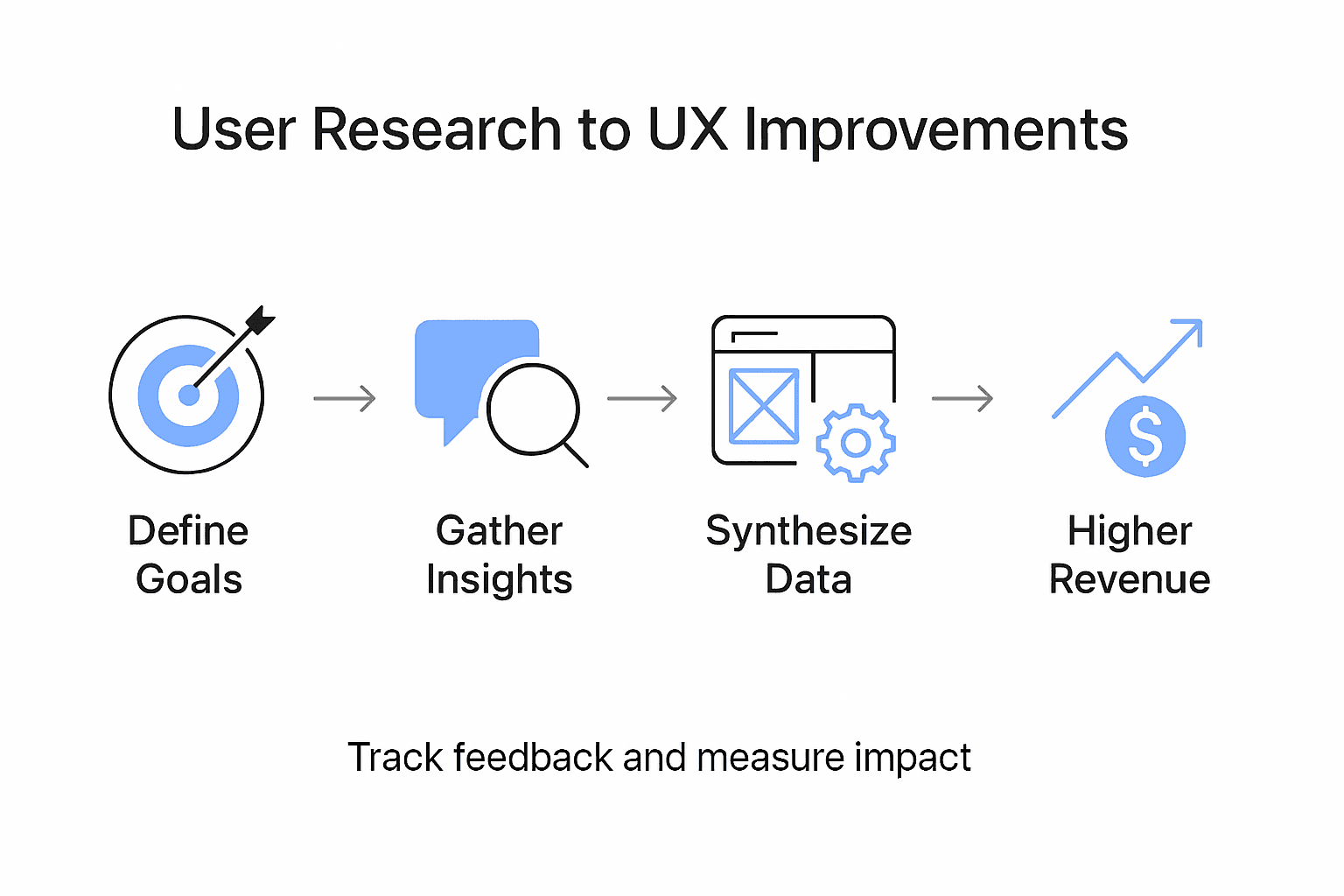
UX methods provide structured techniques for translating research insights into concrete design recommendations. Begin by creating detailed personas that capture the essence of your user segments, highlighting their specific goals, challenges, and motivations. Develop customer journey maps that visualize the user experience, identifying pain points and opportunities for improvement. Use affinity diagrams to cluster similar insights and prioritize design interventions that will have the most significant impact on user satisfaction and product performance.
Prioritize design improvements by considering both user needs and business objectives. Look for opportunities to simplify complex workflows, reduce friction points, and create more intuitive interactions. Create low fidelity prototypes that test your initial design concepts, using your research insights as a guiding framework. Remember that translating research into UX improvements is an iterative process that requires continuous validation and refinement.
Pro tip: Create a research insights repository that tracks how specific user feedback directly influenced product changes, helping your team demonstrate the tangible value of user research.
Step 5: Validate changes and measure impact
Measuring UX impact requires a comprehensive assessment of outcomes across multiple organizational levels that go beyond simple performance metrics. Your validation process should evaluate the effectiveness of design changes through both quantitative and qualitative lenses, ensuring that user experience improvements translate into meaningful business value.
Implement structured measurement techniques to track the impact of your UX modifications. The User Experience Questionnaire provides a standardized approach to quantifying user perceptions across key dimensions like attractiveness, efficiency, and overall user satisfaction. Collect both behavioral metrics (such as task completion rates, time on task, and error rates) and attitudinal data through surveys and user feedback. Compare these metrics against your baseline measurements to understand the tangible improvements resulting from your design changes.
Use this table to identify typical metrics for validating UX improvements:
| Metric Type | Example Metric | What It Reveals |
|---|---|---|
| Behavioral | Task completion rate | Ease of completing product workflows |
| Attitudinal | User satisfaction | Emotional response to product changes |
| Engagement | Time on platform | User interest and repeated usage |
| Error-Based | Error rate | Friction points and design weaknesses |
Establish a continuous feedback loop that allows for ongoing validation and refinement. Create dashboards that track key performance indicators, monitor user engagement metrics, and collect ongoing user feedback. Pay attention to both direct quantitative measurements and nuanced user sentiments that might not be immediately apparent in numerical data. Remember that validation is an iterative process that requires consistent attention and willingness to make further adjustments based on user insights.
Pro tip: Create a standardized impact tracking template that documents specific UX changes, expected outcomes, actual results, and learnings to build an institutional knowledge base of user experience improvements.
Elevate Your SaaS User Research Into Revenue Growth
Mastering the user research workflow is essential to overcome challenges like scattered user insights and unclear product positioning that hold back SaaS growth. Your goal to align business objectives with deeply researched user profiles, synthesize meaningful user needs, and validate impactful UX improvements requires focused expertise and strategic design partnership. At The Good Side Oy, we specialize in turning disconnected user journeys and unprofessional interfaces into cohesive, high-performing experiences that activate users and boost conversions.
Key benefits include
- UX design driven by solid user research insights
- Strategic positioning aligned with your business goals
- Collaborative, flexible engagements that scale with your needs
Ready to transform your SaaS product through targeted user research? Join companies that have accelerated revenue and improved user satisfaction with expert support from The Good Side. Start with a free design audit and experience how our senior, SaaS-focused designers deliver measurable outcomes.
Take the next step now and visit The Good Side to schedule your audit and begin turning user insights into powerful product improvements that drive growth.
Frequently Asked Questions
What are the first steps to define business goals for user research in SaaS?
To define business goals for user research, begin by clarifying your primary objectives, such as increasing user activation or reducing churn. Map out these goals and regularly review them to ensure alignment with your user research initiatives, adjusting as needed to reflect any changes in the market.
How do I create effective user profiles for my SaaS product?
To create effective user profiles, gather both quantitative and qualitative data about your typical users, including demographics and behavior patterns. Develop 3-5 primary personas that encapsulate user motivations, challenges, and technology comfort levels, refining these profiles as you gather more insights over time.
What research methods should I combine for comprehensive user insights?
Combine quantitative methods like online surveys with qualitative techniques such as user interviews and usability testing for richer insights. This multifaceted approach allows you to understand both numerical trends and emotional user experiences, leading to more informed product developments.
How do I synthesize user insights from my research?
Synthesize user insights by organizing collected data into patterns and themes that reveal user motivations and pain points. Use methods like affinity diagrams and collaborative workshops to facilitate analysis and develop visual frameworks that clearly communicate your findings to the team.
What steps should I follow to validate changes and measure the impact of UX improvements?
To validate changes and measure impact, develop structured measurement techniques that track key performance indicators such as user satisfaction and task completion rates. Implement continuous feedback mechanisms to gauge the effectiveness of your UX modifications, adjusting your approaches based on real user insights.
How can user research lead to higher revenue for my SaaS product?
User research can lead to higher revenue by uncovering user needs that directly inform product improvements, enhancing user experience, and increasing customer retention. Act on insights gained to streamline workflows and optimize interactions, aiming for significant usability gains that can boost your revenue within a few months.