Role of UX in Revenue: Driving SaaS Growth

Over 80 percent of American businesses report that user experience directly influences their revenue goals. In a crowded SaaS market, success hinges on more than just flashy designs or clever features. The way customers interact with digital products can determine whether they convert, stay engaged, or move on. This article breaks down how improving UX can drive measurable results, helping companies avoid costly mistakes and maximize long-term growth.
Table of Contents
- Defining UX and Its Revenue Link
- How UX Impacts SaaS Activation and Conversion
- User Experience and Customer Retention Rates
- Quantifying UX ROI in SaaS Products
- Common UX Pitfalls That Hurt Revenue
Key Takeaways
| Point | Details |
|---|---|
| Importance of UX | User experience (UX) is crucial for fostering business growth and improving revenue through enhanced customer interaction and satisfaction. |
| Activation and Conversion | Effective UX design in SaaS elevates activation rates by creating intuitive onboarding processes that guide users seamlessly. |
| Customer Retention | Prioritizing UX can significantly boost customer retention by delivering ongoing value and personalized experiences that meet user needs. |
| Avoiding Common Pitfalls | Addressing complex navigation and unclear value propositions can minimize user drop-off and enhance overall satisfaction, directly influencing revenue. |
Defining UX and Its Revenue Link
User experience (UX) represents the comprehensive journey a customer undergoes while interacting with a product, service, or digital platform. More than just visual design, UX encompasses how users perceive utility, navigate interfaces, and derive value from their interactions. Understanding user experience dynamics reveals it as a critical strategic lever for driving business growth and revenue.
At its core, UX bridges the gap between technological functionality and human interaction. Companies that meticulously craft user experiences transform complex software systems into intuitive, engaging solutions. By prioritizing quantitative UX management through performance indicators, organizations can directly correlate design improvements with measurable business outcomes. This approach allows SaaS companies to systematically enhance product adoption, reduce friction points, and ultimately increase customer lifetime value.
Effective UX design goes beyond aesthetic appeal. It strategically maps user journeys, anticipates potential obstacles, and creates seamless interactions that encourage continued engagement. By understanding user behaviors, preferences, and pain points, businesses can develop products that not only solve problems but also deliver delightful experiences. The revenue impact becomes evident through reduced churn rates, increased user satisfaction, and higher conversion rates across critical customer touchpoints.
Pro Tip: Conduct regular user research and usability testing. Continuously gather feedback through interviews, surveys, and analytics to identify and eliminate user experience barriers that might prevent potential customers from converting or remaining loyal to your product.
How UX Impacts SaaS Activation and Conversion
SaaS product success hinges on transforming initial user interest into sustained engagement through strategic user experience (UX) design. Activation rates represent the critical moment when potential customers transition from curious visitors to active users, and UX plays a pivotal role in this conversion process. Strategic UX writing can dramatically reduce interaction friction, enabling smoother user journeys that guide prospects toward meaningful product interactions.
The conversion funnel in SaaS products demands meticulous attention to user psychology and interaction design. Successful activation strategies involve creating intuitive onboarding experiences, minimizing cognitive load, and providing clear pathways for users to understand product value. This means designing interfaces that anticipate user needs, eliminate unnecessary complexity, and communicate product benefits with remarkable clarity. By carefully mapping user workflows and removing potential barriers, SaaS companies can significantly improve their conversion rates and reduce early-stage user drop-off.
Technical UX considerations directly impact user confidence and product adoption. Elements like streamlined signup processes, progressive feature revelation, contextual guidance, and responsive design all contribute to creating a frictionless experience. Intelligent UX design transforms complex software interactions into engaging, almost intuitive experiences that feel natural and effortless. When users can quickly comprehend a product’s value proposition and navigate its features with minimal resistance, they are far more likely to complete activation and become committed users.
Pro Tip: Implement micro-interactions and contextual tooltips that provide just-in-time guidance. Design subtle, informative cues that help users understand product functionality without overwhelming them with complex instructions or excessive information.
User Experience and Customer Retention Rates
Customer retention represents a critical metric for SaaS businesses, with user experience (UX) playing a fundamental role in determining whether users continue engaging with a product. Measuring and optimizing UX can dramatically improve customer retention strategies, transforming potential churn points into opportunities for deeper user connection. Retention rates are not merely statistical indicators but reflections of how well a product meets and anticipates user expectations.

Successful SaaS companies understand that retention goes beyond initial product functionality. It involves creating continuous value through intuitive design, personalized experiences, and proactive user support. This means developing interfaces that adapt to user behaviors, provide seamless navigation, and consistently demonstrate product value. By reducing friction points and creating engaging interaction models, companies can transform casual users into loyal advocates who see the product as an indispensable part of their workflow.
The connection between UX and retention is multifaceted, involving psychological and functional elements. Factors like visual consistency, responsive design, personalized onboarding experiences, and intelligent feature discovery all contribute to users feeling understood and supported. When users perceive that a product is designed with their specific needs and challenges in mind, they are more likely to invest time in learning and mastering the platform. This emotional connection transcends mere utility, creating a sense of partnership between the user and the product.
Pro Tip: Implement user feedback loops and regular experience surveys. Create multiple low-friction channels for users to share insights, and demonstrate that you are actively listening and evolving based on their input.
Quantifying UX ROI in SaaS Products
Measuring the return on investment (ROI) for user experience requires a strategic approach that goes beyond traditional financial metrics. Quantitative management of UX through key performance indicators provides a structured framework for understanding how design improvements translate directly into business value. UX ROI is not a theoretical concept but a measurable outcome that can be tracked through specific, actionable metrics that connect user experience to revenue generation.
Effective UX ROI calculation involves analyzing multiple interconnected indicators. These include customer acquisition cost, user activation rates, conversion rates, customer lifetime value, and retention metrics. By establishing a comprehensive measurement framework, SaaS companies can demonstrate the tangible financial impact of design investments. For instance, reducing user onboarding friction by 20% might translate into a significant increase in conversion rates, directly impacting top-line revenue and bottom-line profitability.
The most sophisticated UX ROI models integrate both quantitative and qualitative data. Quantitative metrics like reduced support tickets, increased feature adoption, and improved user engagement provide concrete numerical evidence. Qualitative insights from user feedback, usability testing, and satisfaction surveys offer deeper context, helping companies understand the nuanced ways that design improvements influence user perception and behavior. This holistic approach transforms UX from a subjective design discipline into a strategic business lever with measurable financial outcomes.
Pro Tip: Develop a standardized UX impact dashboard that tracks key performance indicators across user journey stages. Integrate both financial and experiential metrics to create a comprehensive view of how design investments drive business growth.
Here’s a summary of how UX improvements can impact key SaaS business metrics:
| Business Metric | Positive UX Impact | Revenue Effect |
|---|---|---|
| Activation Rate | Smoother onboarding, less confusion | Higher trial-to-user conversion |
| Retention Rate | Easier workflows, personalized help | Greater customer lifetime value |
| Support Load | Clearer navigation, fewer issues | Lower support costs |
| Feature Adoption | Intuitive feature discovery | More upsell and cross-sell opportunities |
| Churn Rate | Consistently delightful experience | Reduced user cancellations |
Common UX Pitfalls That Hurt Revenue
Complex interfaces and poorly designed user experiences can transform promising SaaS products into revenue-draining platforms. Rising customer acquisition costs directly correlate with unintuitive design challenges, creating significant barriers to sustainable growth. Understanding these critical UX pitfalls becomes essential for SaaS companies seeking to optimize their revenue generation potential.
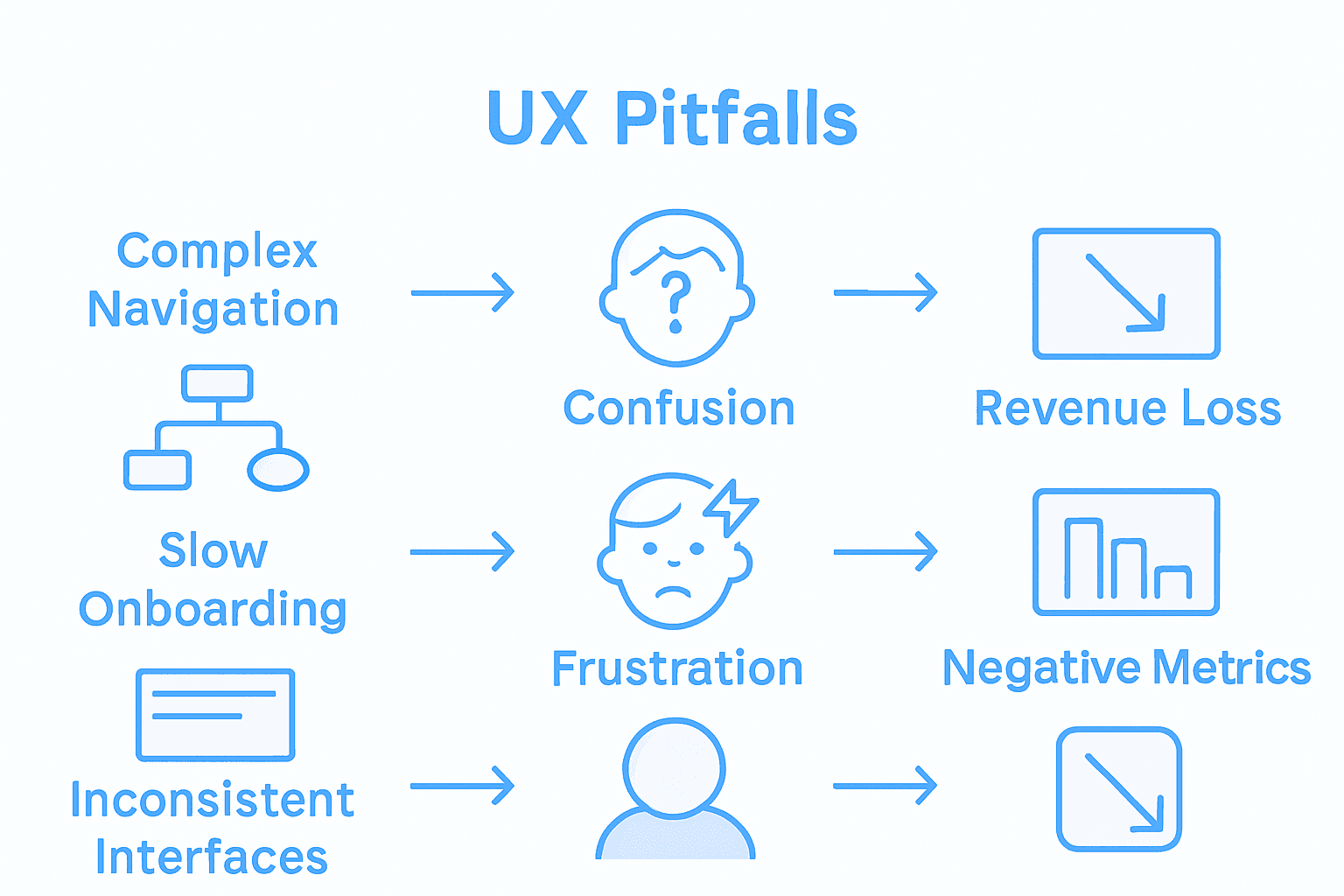
One of the most damaging UX mistakes involves creating friction-filled interaction points that discourage user engagement. Strategic communication can dramatically reduce conversion barriers, yet many SaaS products continue to implement confusing navigation, overwhelming feature sets, and unclear value propositions. These design failures manifest through increased user drop-off rates, reduced feature adoption, and ultimately diminished customer lifetime value. Problematic UX elements like counterintuitive workflows, excessive onboarding steps, and inconsistent design language can transform potential customers into frustrated abandoned users.
The revenue impact of poor UX extends beyond immediate conversion challenges. Ineffective design creates downstream consequences that compound financial losses. Excessive support tickets, increased customer churn, negative word-of-mouth recommendations, and higher customer acquisition costs all stem from fundamental UX weaknesses. SaaS companies that fail to prioritize user-centric design inadvertently create expensive feedback loops where poor experiences generate increasing operational costs and reduced market competitiveness.
Below is a comparison of common UX pitfalls and their direct business consequences:
| UX Pitfall | User Impact | Business Consequence |
|---|---|---|
| Complex Navigation | Users get lost or frustrated | Higher abandonment, lower conversions |
| Overwhelming Features | Users feel intimidated | Poor adoption, low satisfaction |
| Inconsistent Design | Users lack trust, feel confused | Negative brand perception, less loyalty |
| Unclear Value Proposition | Users do not grasp benefits | Missed sales, slow growth |
| Excessive Onboarding Steps | Users drop out early | Fewer active users, increased churn |
Pro Tip: Conduct monthly user experience audits. Systematically review your product’s interaction points, gather quantitative and qualitative feedback, and implement incremental improvements to reduce user friction and enhance overall engagement.
Unlock SaaS Growth by Transforming Your User Experience Today
The article highlights how poor UX directly hurts SaaS revenue through complex interfaces, unclear value propositions, and friction-filled user journeys that increase churn and reduce activation rates. If your SaaS product struggles with user confusion, low retention, or slow conversions, these challenges may be holding back your growth potential. The Good Side Oy specializes in turning those exact pain points into strengths by delivering expert UI/UX design, user research, and strategic positioning tailored specifically for SaaS companies.
Don’t let subpar UX drain your revenue. Partner with The Good Side to streamline onboarding, enhance feature adoption, and create seamless, engaging user journeys that drive activation and retention. Our flexible engagements with senior SaaS-focused designers start with a free design audit and can scale from part-time consulting to fully embedded teams within just weeks. Experience measurable impact on your activation rates and customer lifetime value by aligning your product, website, and onboarding into a cohesive experience.
Ready to elevate your SaaS product and accelerate revenue growth with proven UX strategies From expert user research to end-to-end journey optimization The Good Side is your strategic partner. Get started now by visiting The Good Side and discover how to transform your UX challenges into a high-performing product that users love.
Frequently Asked Questions
How does user experience (UX) affect revenue in SaaS?
User experience impacts revenue by driving customer satisfaction, increasing conversion rates, and reducing churn, ultimately enhancing the overall customer lifetime value. A well-designed UX can lead to smoother user journeys, fostering engagement and loyalty.
What are some key metrics to measure UX ROI in SaaS products?
Key metrics include customer acquisition cost, activation rates, conversion rates, customer lifetime value, and retention metrics. Tracking these indicators helps demonstrate the financial impact of UX improvements on business growth.
What are common UX pitfalls that can hinder revenue growth?
Common UX pitfalls include complex interfaces, overwhelming features, inconsistent design, unclear value propositions, and excessive onboarding steps. These issues can lead to user frustration, increased churn, and lower conversion rates.
How can companies improve their SaaS activation rates through UX design?
Companies can improve activation rates by creating intuitive onboarding experiences, reducing cognitive load, and closely mapping user journeys. Clear communication of product benefits and minimizing friction in user interactions are essential for converting potential customers into active users.