Role of UX in Activation: Driving SaaS User Success

More than 60 percent of american SaaS products lose new users before they experience real value. Frustration often sets in when onboarding feels confusing or product benefits are unclear. User activation is not just about a quick registration, but about guiding every customer through a journey that shows their time is well spent. This article uncovers practical UX strategies to turn first-time users into loyal advocates, helping teams nurture lasting product engagement and conversion.
Table of Contents
- Defining User Activation In SaaS UX
- Key UX Elements That Influence Activation
- UX Strategies For Optimizing Onboarding
- Measuring Activation Impact With UX Metrics
- Common UX Mistakes That Hinder Activation
Key Takeaways
| Point | Details |
|---|---|
| User Activation is Crucial | User activation is the transition from signing up to meaningful engagement with a SaaS product’s features, emphasizing the importance of demonstrating immediate value. |
| Key UX Elements Impact Engagement | Intuitive navigation, strong visual design, and performance optimization are essential for enhancing user activation and driving sustained usage. |
| Effective Onboarding is Key | Personalized onboarding experiences using emotional design and progressive disclosure techniques can significantly reduce early drop-off rates and improve user confidence. |
| Measure Activation Holistically | A balanced measurement framework that integrates both quantitative metrics and qualitative insights is vital for understanding user activation and long-term retention. |
Defining User Activation in SaaS UX
User activation represents the pivotal moment when a potential customer transitions from merely signing up for a SaaS product to actually experiencing its core value and engaging meaningfully with its features. In the context of user experience, activation is not just about initial interaction but creating a compelling journey that demonstrates immediate utility and encourages sustained usage.
At its core, user activation tracks how effectively a SaaS platform transforms curious prospects into committed users who recognize and leverage the product’s core capabilities. This process goes beyond simple login metrics, focusing instead on meaningful engagement signals like completing key onboarding steps, performing critical actions, or reaching specific product milestones that indicate genuine value discovery. Successful activation strategies systematically reduce friction, provide clear guidance, and create intuitive pathways that help users quickly understand how the product solves their specific problems.
Designing an effective activation process requires deep understanding of user motivations, pain points, and expectations. Product managers must craft user experiences that not only introduce features but also create emotional connections by demonstrating tangible benefits within the first few interactions. This means developing onboarding flows that are contextual, personalized, and aligned with different user personas and their unique objectives.
Pro Tip - Activation Optimization: Map out your ideal user journey by creating precise activation benchmarks that define what successful product engagement looks like for different user segments, then design targeted experiences that help users reach those milestones quickly and effortlessly.
Key UX Elements That Influence Activation
SaaS user activation hinges on several critical UX design elements that transform initial product interactions into meaningful engagement. Research on mobile application design highlights how strategic UX principles can significantly impact user retention and conversion rates. The most influential elements include intuitive navigation, visual design, performance optimization, and personalized user experiences that systematically reduce cognitive friction.
Navigation and information architecture play pivotal roles in user activation. Users must quickly understand how to move through the product, locate critical features, and accomplish their primary objectives with minimal cognitive effort. This requires designing clear user flows, implementing logical menu structures, and providing contextual guidance that helps users intuitively understand product functionality. Effective navigation reduces user frustration and increases the likelihood of users reaching meaningful activation points.

Visual design and interactive elements are equally crucial in driving activation. Well-designed interfaces communicate product value through aesthetic appeal, consistent design language, and strategic use of visual hierarchy. Color schemes, typography, iconography, and interactive animations can guide user attention, provide feedback, and create emotional connections that encourage deeper product exploration. By creating visually engaging experiences that feel both professional and approachable, SaaS products can significantly enhance user motivation and reduce early abandonment rates.
Here’s how common UX elements each contribute to SaaS user activation:
| UX Element | How It Boosts Activation | Potential Business Impact |
|---|---|---|
| Intuitive Navigation | Reduces confusion, guides progress | Faster onboarding, fewer drop-offs |
| Visual Design | Communicates value, builds trust | Higher user engagement rates |
| Performance Optimization | Ensures smooth first experiences | Increased conversion, less churn |
| Personalization | Aligns product with user needs | Better retention, loyal customers |
Pro Tip - UX Design Focus: Create a comprehensive UX audit checklist that systematically evaluates navigation clarity, visual consistency, and interactive feedback mechanisms to identify and eliminate potential activation barriers in your product experience.
UX Strategies for Optimizing Onboarding
Effective onboarding represents the critical gateway between initial user signup and sustained product engagement. The primary goal is to transform new users from curious prospects into confident, active participants by creating an intuitive and emotionally resonant experience. Affective design principles emphasize the importance of crafting interfaces that not only guide users through product features but also generate positive emotional connections that motivate continued exploration and learning.
Successful onboarding strategies incorporate progressive disclosure techniques that introduce product complexity gradually, preventing user overwhelm while maintaining engagement. This means breaking down complex workflows into digestible steps, providing contextual tooltips, and creating interactive tutorials that allow users to learn by doing. Personalization plays a crucial role in this process, enabling products to adapt onboarding experiences based on user roles, industry, or specific use cases, which helps users quickly recognize the product’s unique value proposition.
Emotional design becomes paramount in creating memorable onboarding experiences that transcend mere functional instruction. Emotional design principles suggest that users connect more deeply with products when they can relate to them on a personal level. This means incorporating welcoming language, celebrating small user achievements, using engaging microinteractions, and designing visual interfaces that feel both professional and approachable. By transforming onboarding from a technical necessity into an enjoyable journey, SaaS products can significantly reduce early user dropout rates and accelerate time-to-value.
Pro Tip - Onboarding Optimization: Develop a structured onboarding measurement framework that tracks key engagement metrics like time-to-first-value, feature discovery rate, and user satisfaction scores to continuously refine and personalize your product’s initial user experience.
Measuring Activation Impact With UX Metrics
Measuring user activation requires a nuanced approach that goes beyond traditional quantitative metrics, incorporating both behavioral and emotional insights. Research on information engagement models highlights the importance of developing comprehensive frameworks that capture the multidimensional nature of user interaction. The READ model provides a sophisticated approach to quantifying engagement by examining representativeness, ease of use, affect, and distribution, offering SaaS teams a more holistic view of activation performance.
Key UX metrics for tracking activation impact include both functional and experiential indicators. Core quantitative metrics like time-to-first-value, feature adoption rate, and conversion percentages provide baseline performance insights. However, these must be complemented by qualitative measurements that capture user sentiment and emotional response. Personality-based usability research demonstrates how individual user traits can significantly influence interaction patterns, suggesting the need for more nuanced metrics that account for user diversity and personalization.
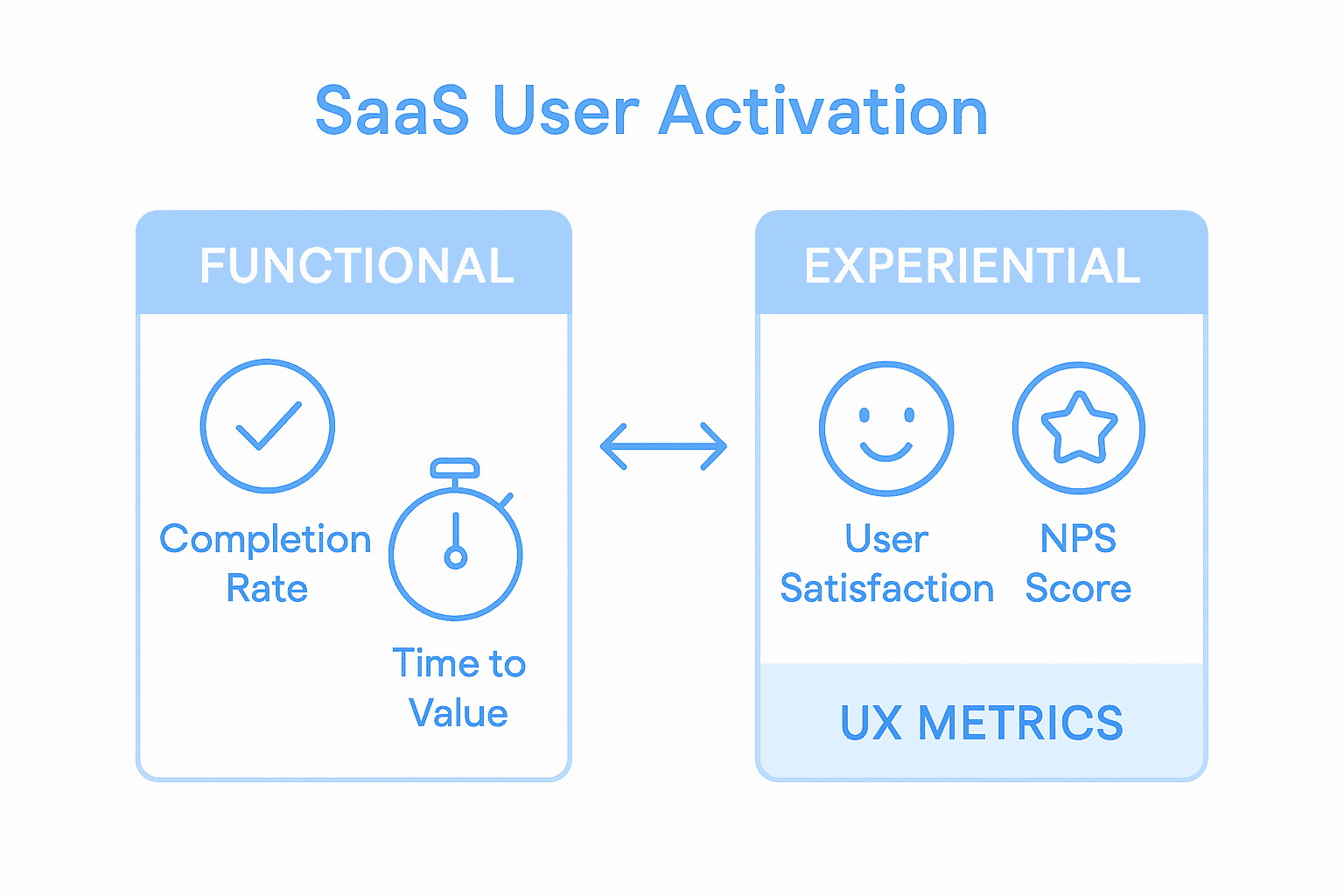
Advanced activation measurement requires a multi-dimensional approach that synthesizes quantitative performance data with user experience insights. This means creating comprehensive dashboards that track not just technical usage metrics, but also user satisfaction scores, emotional engagement levels, and behavioral patterns. Successful SaaS teams develop custom activation scorecards that combine objective performance indicators with subjective user experience signals, enabling more precise understanding of how UX design impacts user adoption and long-term retention.
Below is a quick comparison of quantitative and qualitative UX metrics for measuring activation effectiveness:
| Metric Type | Example Metric | What It Reveals |
|---|---|---|
| Quantitative | Time-to-first-value | Speed of initial user success |
| Quantitative | Feature adoption rate | Depth of product usage |
| Qualitative | User satisfaction score | Sentiment about onboarding experience |
| Qualitative | Emotional engagement | Level of personal connection |
Pro Tip - Metrics Strategy: Develop a holistic activation measurement framework that balances quantitative usage data with qualitative user experience insights, creating a more comprehensive view of product engagement and user success.
Common UX Mistakes That Hinder Activation
SaaS products frequently encounter activation barriers due to fundamental UX design missteps that undermine user engagement and perceived value. Computer user satisfaction research demonstrates that technological interactions must be carefully adapted to psychological preferences, highlighting how seemingly minor UX errors can significantly derail user adoption and retention. The most critical mistakes often involve complex onboarding processes, overwhelming interfaces, and a failure to communicate immediate product value.
One primary activation impediment is cognitive overload, where products bombard users with excessive information, features, and configuration options during initial interactions. This approach overwhelms users, creating decision paralysis that prevents meaningful engagement. Effective UX design demands progressive feature revelation, allowing users to incrementally explore product capabilities without feeling intimidated. Successful SaaS platforms create streamlined initial experiences that guide users toward quick, meaningful wins, demonstrating core value propositions within the first few minutes of interaction.
Another significant activation mistake involves neglecting user empathy and personalization. Generic onboarding flows that treat all users identically fail to address diverse user needs, motivations, and skill levels. Modern SaaS products must implement adaptive onboarding strategies that recognize individual user contexts, providing tailored guidance, relevant feature demonstrations, and contextual support. By understanding and addressing unique user requirements, products can transform potentially frustrating initial interactions into engaging, supportive experiences that accelerate activation and long-term retention.
Pro Tip - User Experience Audit: Conduct regular user testing sessions that map out actual user journeys, identifying and eliminating friction points that prevent smooth product activation and engagement.
Unlock Seamless SaaS User Activation with Expert UX Design
The article highlights the critical challenge of transforming new users into engaged, loyal customers through clear navigation, personalized onboarding, and emotional design. If your SaaS product struggles with cognitive overload or generic experiences that hinder activation, you are not alone. Achieving fast time-to-first-value and meaningful user milestones requires more than just features—it demands strategic UX and user journey optimization tailored to diverse user needs.
At The Good Side Oy, we specialize in partnering with SaaS companies to turn complex, disconnected user flows into cohesive, intuitive experiences that drive activation and long-term retention. Our senior designers focus on reducing friction, creating emotional connections, and aligning product positioning for measurable impact. From a free design audit to flexible consulting or embedded design support, we enable teams to accelerate user engagement without the delays of traditional hiring.
Ready to transform your onboarding and boost activation rates now? Visit The Good Side Oy to start your free design audit and explore how our UX experts can quickly deliver tailored solutions that convert more users into committed customers. Don’t let unclear journeys stall your growth—take action today and experience the difference of strategic SaaS UX design.
Frequently Asked Questions
What is user activation in SaaS?
User activation in SaaS refers to the moment when a new user starts to realize the core value of a product, moving from mere signup to meaningful engagement with its features. It involves completing key onboarding steps and performing significant actions that demonstrate the product’s usefulness.
How can UX design impact user activation in SaaS?
Effective UX design directly influences user activation by providing intuitive navigation, appealing visual design, and personalized experiences that reduce cognitive friction, making it easier for users to understand and engage with the product’s core functionalities.
What are the key elements of an effective onboarding process?
An effective onboarding process includes progressive disclosure of information, personalized experiences based on user needs, contextual tooltips, and interactive tutorials that guide users through essential features without overwhelming them.
How can I measure the impact of UX on user activation?
Measuring the impact of UX on user activation can be done using a combination of quantitative metrics (like time-to-first-value and feature adoption rate) and qualitative metrics (such as user satisfaction scores and levels of emotional engagement) to get a comprehensive view of user interactions and satisfaction.