End-to-End UX Optimization for SaaS: A Complete Guide

Over 60 percent of SaaS startups struggle to deliver a seamless user experience that truly resonates with their audience. For any American company aiming to stand out in a fast-paced market, understanding and prioritizing real user needs is no longer optional. Discover how a thoughtfully designed, user-centered process transforms digital products from just functional to genuinely loved, setting the stage for lasting engagement and measurable business impact.
Table of Contents
- Step 1: Define Target Personas And Product Goals
- Step 2: Map Current User Journeys And Identify Gaps
- Step 3: Redesign Interfaces For Cohesive Experiences
- Step 4: Integrate Data-Driven UX Improvements
- Step 5: Test User Flows And Validate Enhancements
- Step 6: Monitor Performance And Iterate Continuously
Quick Summary
| Insight | Explanation |
|---|---|
| 1. Understand Users Deeply | Conduct thorough research to develop user personas, capturing their needs, goals, and pain points for better product alignment. |
| 2. Map User Journeys | Visualize all user interactions with your product to identify gaps and improve the overall user experience. |
| 3. Redesign with Purpose | Perform an interface audit and ensure redesigns prioritize user needs for more intuitive interactions. |
| 4. Leverage Data Insights | Use quantitative and qualitative data to make informed UX improvements that address user pain points. |
| 5. Continuously Monitor Performance | Establish a feedback loop to refine design and maintain user engagement based on performance metrics. |
Step 1: Define target personas and product goals
Creating accurate user personas and defining clear product goals are foundational steps in building a successful SaaS product. By developing detailed user representations, you’ll create a strategic roadmap that transforms abstract user needs into concrete design objectives.
Start by conducting comprehensive research to uncover the nuanced characteristics of your potential users. This means diving deep into demographic data, behavioral patterns, professional challenges, and personal motivations. Use surveys, interviews, and analytics to build multi dimensional personas that go beyond surface level descriptions. For each persona, map out their goals, pain points, technology comfort levels, and specific professional contexts.
As you develop these personas, simultaneously outline your product goals. These should directly connect to the user needs you’ve identified. Think about what specific problems your SaaS solution will solve, what unique value proposition you offer, and how your product will measurably improve users’ workflows. User experience research demonstrates that personas help align product development with genuine user requirements, creating more intuitive and effective solutions.
Pro Tip: Create visualization tools like persona cards or journey maps that your entire team can reference, ensuring everyone maintains a consistent understanding of your target users and strategic objectives.
Step 2: Map current user journeys and identify gaps
Mapping user journeys is a critical process for understanding how your SaaS product delivers value across different interaction points. Systematic user journey mapping allows you to visualize the entire user experience from initial touchpoint to long term engagement.

Begin by documenting every possible interaction a user might have with your product. This means tracing each step from initial awareness through signup, onboarding, active usage, and potential expansion or churn. Create a comprehensive visual representation that captures not just the functional steps but also the emotional states and potential friction points users experience. Use tools like flowcharts, swimlane diagrams, or specialized journey mapping software to capture these nuanced interactions.
As you map the journey, actively look for gaps and potential areas of improvement. Analyze where users might experience confusion, unnecessary complexity, or points of potential dropout. Pay special attention to transitions between different stages of the user experience where cognitive load or frustration might increase. Consider collecting quantitative data through analytics platforms and qualitative insights through user interviews to validate and enrich your journey map.
Pro Tip: Color code different emotional states within your user journey map to quickly identify where users might feel frustrated, neutral, or delighted throughout their interaction with your product.
Step 3: Redesign interfaces for cohesive experiences
Redesigning interfaces requires a strategic approach that goes beyond aesthetic changes. User-centered design principles demand that every interface modification directly supports user needs and workflows, transforming complex interactions into intuitive experiences.
Start by conducting a comprehensive interface audit, examining each screen and interaction point through the lens of user functionality and emotional response. Break down existing interfaces into individual components, analyzing how they connect and whether they create a seamless narrative for users. Leverage affective design techniques to ensure your redesign not only looks appealing but also evokes the right emotional responses that align with your product’s core value proposition.
Implement a systematic redesign approach by prioritizing consistency across all interface elements. Develop a robust design system that establishes clear guidelines for typography, color palettes, interaction states, and component behaviors. This ensures that every interface element feels like part of a cohesive whole, reducing cognitive friction and helping users navigate your product more efficiently. Test your redesigned interfaces with actual users, gathering both quantitative metrics and qualitative feedback to validate your design choices.
Pro Tip: Create a design language document that serves as a living reference for your entire team, detailing precise interaction patterns, visual hierarchies, and emotional design principles to maintain interface consistency.
Step 4: Integrate data-driven UX improvements
Integrating data-driven UX improvements requires a systematic approach that transforms user insights into actionable design strategies. Systematic mapping protocols for UX design provide a structured framework for understanding and implementing meaningful user experience enhancements.
Begin by establishing a comprehensive data collection strategy that captures multiple dimensions of user interaction. Leverage analytics platforms, user feedback tools, session recordings, and heat maps to gather quantitative and qualitative data about user behaviors. Look beyond surface level metrics to understand deeper patterns of user engagement. Goal-oriented persona modeling can help you reframe user data into actionable insights, revealing implicit user needs and potential friction points that traditional analytics might overlook.
The table below compares quantitative and qualitative UX data collection methods used in SaaS design:
| Method Type | Common Tools | Insights Provided |
|---|---|---|
| Quantitative | Analytics platforms, heatmaps | User patterns, conversion rates |
| Qualitative | Interviews, surveys, session recordings | User motivations, pain points |
Transform your collected data into concrete UX improvements by creating a prioritized roadmap. Identify the most significant user pain points, validate them through multiple data sources, and develop targeted solutions. Implement A/B testing to validate your proposed improvements, measuring their impact on key performance indicators like user engagement, conversion rates, and retention. Continuously iterate on your design, treating UX as an ongoing process of refinement rather than a one time project.

Pro Tip: Create a centralized UX insights dashboard that allows your entire product team to access and understand user data in real time, ensuring design decisions are always grounded in actual user behavior.
Step 5: Test user flows and validate enhancements
Testing user flows requires a strategic approach that uncovers the nuanced interactions between your product and its users. Understanding developer and user perception gaps is crucial for identifying potential friction points and validating meaningful product improvements.
Develop a comprehensive testing strategy that combines multiple research methods. Utilize user story mapping and journey techniques to capture detailed user interactions and experiences. Implement both qualitative and quantitative testing approaches including user interviews, usability testing sessions, heuristic evaluations, and comprehensive analytics tracking. Create scenarios that simulate real world user interactions across different user personas and use cases. Pay special attention to transition points between features where users might experience confusion or drop off.
Validate your enhancements through structured experimentation. Use A/B testing to compare different design approaches, measuring key metrics like task completion rates, time on task, user satisfaction scores, and conversion rates. Collect both objective performance data and subjective user feedback to build a holistic understanding of your product improvements. Remember that validation is an iterative process requiring continuous refinement and openness to user insights.
Pro Tip: Create a standardized testing template that includes predefined success criteria and key performance indicators to ensure consistent and objective evaluation of user flow enhancements.
Step 6: Monitor performance and iterate continuously
Continuous performance monitoring is the cornerstone of exceptional user experience design. User-centered design principles emphasize the importance of ongoing evaluation and refinement to ensure your product remains responsive to user needs and expectations.
Establish a robust monitoring framework that captures both quantitative performance metrics and qualitative user sentiment. Leverage advanced analytics platforms to track key performance indicators like user engagement, retention rates, feature adoption, and conversion metrics. Simultaneously, integrate emotional response tracking to understand the deeper psychological impact of your product design. This means going beyond traditional metrics to assess how users feel when interacting with your interface through sentiment analysis, user feedback surveys, and emotional response mapping.
Develop a systematic iteration process that transforms insights into actionable improvements. Create a feedback loop where user data directly informs product evolution. Schedule regular design review sessions where your team can analyze performance data, discuss user feedback, and prioritize potential enhancements. Implement a transparent prioritization framework that balances technical feasibility with user impact. Remember that iteration is not about constant dramatic changes but incremental, meaningful improvements that progressively enhance user experience.
Pro Tip: Create a quarterly design health dashboard that visualizes key performance trends, making it easy for your entire team to understand and act on user experience insights at a glance.
Here’s a summary of key activities and their benefits for each step in designing a SaaS product:
| Step | Core Activity | Main Benefit |
|---|---|---|
| Define Personas & Goals | Research users and clarify goals | Aligns product with target needs |
| Map User Journeys | Visualize user interactions | Uncovers pain points and gaps |
| Redesign Interfaces | Audit and update UX design | Delivers intuitive user experience |
| Data-driven Improvements | Leverage analytics & feedback | Prioritizes evidence-based changes |
| Test User Flows | Evaluate and validate enhancements | Ensures usability and satisfaction |
| Monitor & Iterate | Track metrics, refine design | Sustains ongoing user engagement |
Unlock Seamless UX Optimization for Your SaaS Product
The article “End-to-End UX Optimization for SaaS: A Complete Guide” highlights the critical challenges SaaS teams face including disconnected user journeys, unclear positioning, and scattered interface designs that frustrate users and limit growth. If your team struggles with turning deep user insights into cohesive, data-driven improvements or ensuring ongoing user validation and iteration, you are not alone. These pain points can slow activation, conversions, and revenue impact, making it essential to revisit every step from persona definition to continuous performance monitoring.
At The Good Side, we specialize in tackling exactly these challenges through expert UI/UX design, strategic user research, and end-to-end journey optimization crafted for SaaS companies. Our senior designers bring focused experience that aligns your product goals with clear user personas and fluid journeys that resonate emotionally and function smoothly. Whether you need flexible consulting or fully embedded design support, our proven process accelerates your product transformation starting with a complimentary design audit and rapid talent matching.
Transform your UX strategy today with trusted design partners who understand the nuances covered in the guide.
Get a clear advantage and start scaling faster now
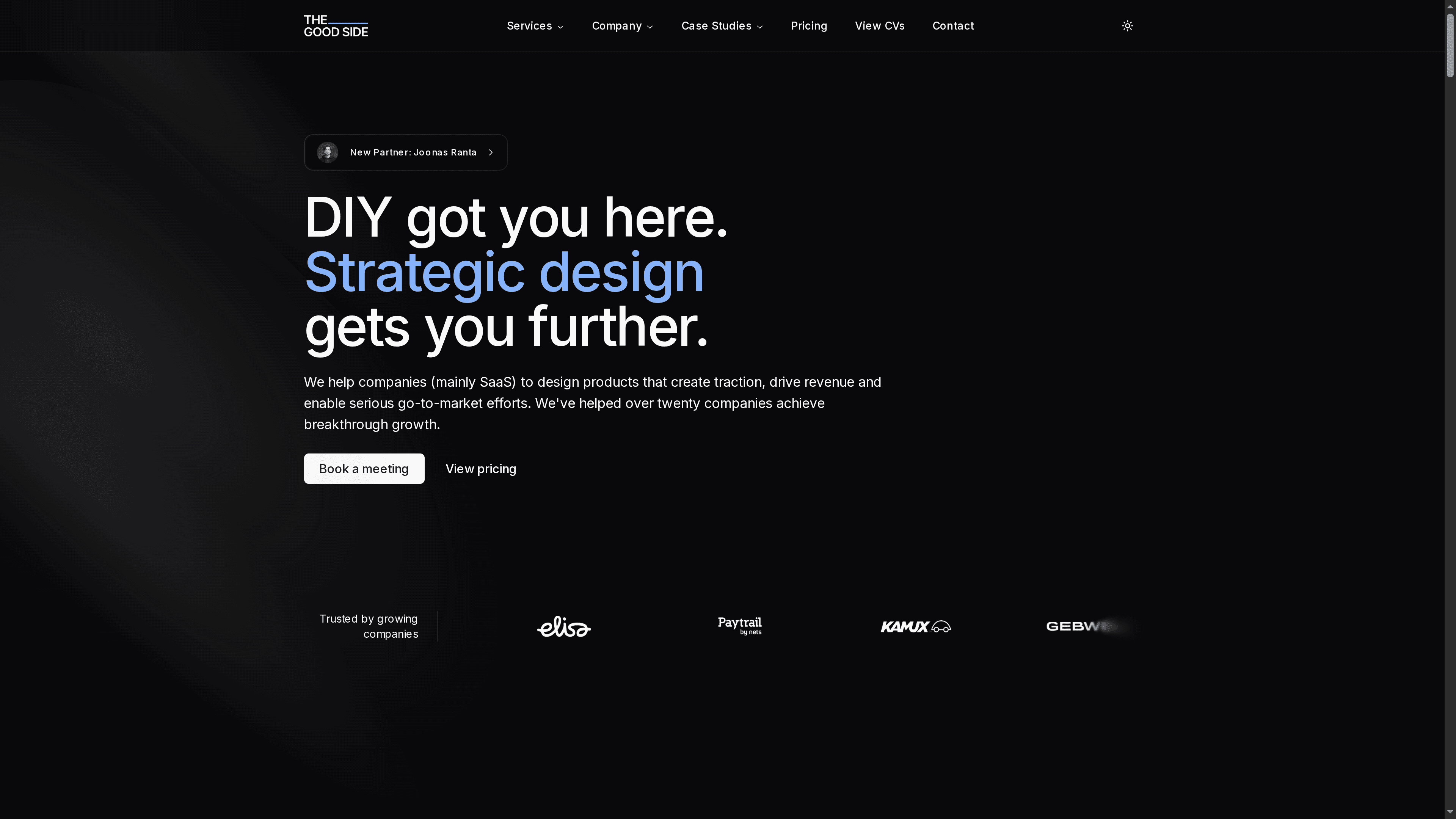
Explore how The Good Side can integrate data-driven insights and user-centered design principles to boost your SaaS success. Visit The Good Side to claim your free design audit and take the next step toward a unified and high-performing product experience.
Frequently Asked Questions
What are the first steps to optimize user experience in a SaaS product?
Start by defining target personas and outlining clear product goals. Conduct thorough research on user demographics and needs, then create detailed personas that inform your design and development decisions.
How can I effectively map user journeys for my SaaS product?
To map user journeys, document all user interactions from initial awareness to ongoing engagement. Create visual representations of these journeys to identify pain points and opportunities for enhancement.
What should I consider when redesigning interfaces for better usability?
Focus on user-centered design principles that prioritize functionality and emotional response. Conduct an interface audit, analyze each element, and ensure consistency across all screens to create a cohesive user experience.
How can I integrate data-driven improvements into my UX design process?
Establish a comprehensive strategy to collect both quantitative and qualitative data on user behavior. Analyze this data to identify significant pain points and prioritize improvements based on user impact.
How do I test and validate user flows before implementing changes?
Develop a comprehensive testing strategy that combines qualitative and quantitative methods. Use techniques such as usability testing and A/B testing to evaluate user flows and measure key performance indicators before finalizing enhancements.
What ongoing processes should I implement to monitor UX performance?
Continuously monitor user engagement metrics and gather qualitative feedback to refine your design. Schedule regular reviews of performance data to identify trends and prioritize incremental improvements that enhance user experience.